In 2024, the European Union adopted groundbreaking legislation regulating the use of artificial intelligence – the AI Act (EU Regulation 2024/1689). It is the world’s first piece of legislation to set out in detail the circumstances and principles under which AI may be used in commercial activities. For business owners and marketers commissioning the production of video adverts, this is a key change.
As AI-generated video (synthetic voices, faces, animations and deepfakes) becomes increasingly popular, new legal obligations are also emerging. If your campaign features content created by artificial intelligence, it must be clearly labelled as such – otherwise, you could expose your company to serious consequences.
What exactly does the AI Act introduce?
The AI Act does not prohibit the use of artificial intelligence in marketing – on the contrary, it allows for many creative applications. But it sets clear boundaries:
It prohibits unethical practices (e.g. emotional manipulation, exploitation of vulnerable groups).
It introduces an obligation to label AI-generated content that may be misleading as to its authenticity.
It introduces a system of financial penalties for entities that breach the regulations.
When do the regulations come into force?
1 August 2024 – The AI Act comes into force.
2 February 2025 – legislation prohibiting the manipulative use of AI and requiring so-called ‘AI literacy’ comes into force.
2 August 2025 – financial sanctions and reporting obligations for content recipients come into force.
2 August 2026 – full implementation of the AI Act for high-risk systems.
For the marketing and advertising sector, the second and third dates are crucial – from February 2025, AI-generated content must be properly labelled, and from August 2025, failure to do so will result in actual penalties.
What information must be included in video adverts?
If you are creating or commissioning a campaign that contains AI-generated content, you must label it in a way that is clear, unambiguous and understandable to the audience. This applies, amongst other things, to:
voices of narrators generated by AI,
animated character faces,
virtual presenters,
computer-generated scenery and locations that mimic reality.
What is permitted – and how should it be correctly labelled?
1. A synthetic voice-over
Example: A product advert featuring an AI voice created using ElevenLabs.
Designation: “The voice in this material was generated by artificial intelligence.”
2. Virtual AI presenter
Example: A campaign featuring an AI character speaking to the camera.
Designation: “The character featured in this material was created using AI. This is not a real person.”
3. A scene from a journey generated by AI
Example: A shot of mountains or a city that does not exist, generated by Sora.
Designation: “The scenes in this advert were computer-generated.”
What is not allowed?
1. Impersonating real people
It is not possible to: using AI to recreate the image or voice of a well-known person without their consent and without labelling it as such.
Risk: infringement of the right to one’s own image and Article 50 of the AI Act.
2. Modifying existing material without disclosing AI
intervention. It is not permitted to: insert a product into a shot taken from a different context and suggest that it is authentic material.
Risk: misleading the consumer – subject to sanctions.
3. Failure to label a deepfake
It is not possible to: to create adverts featuring a realistic person generated by AI without labelling it as synthetic content.
Risk: a fine of up to 15 million euros or 3 per cent of turnover.
VIDEOSPACE: We’re ready for the AI Act
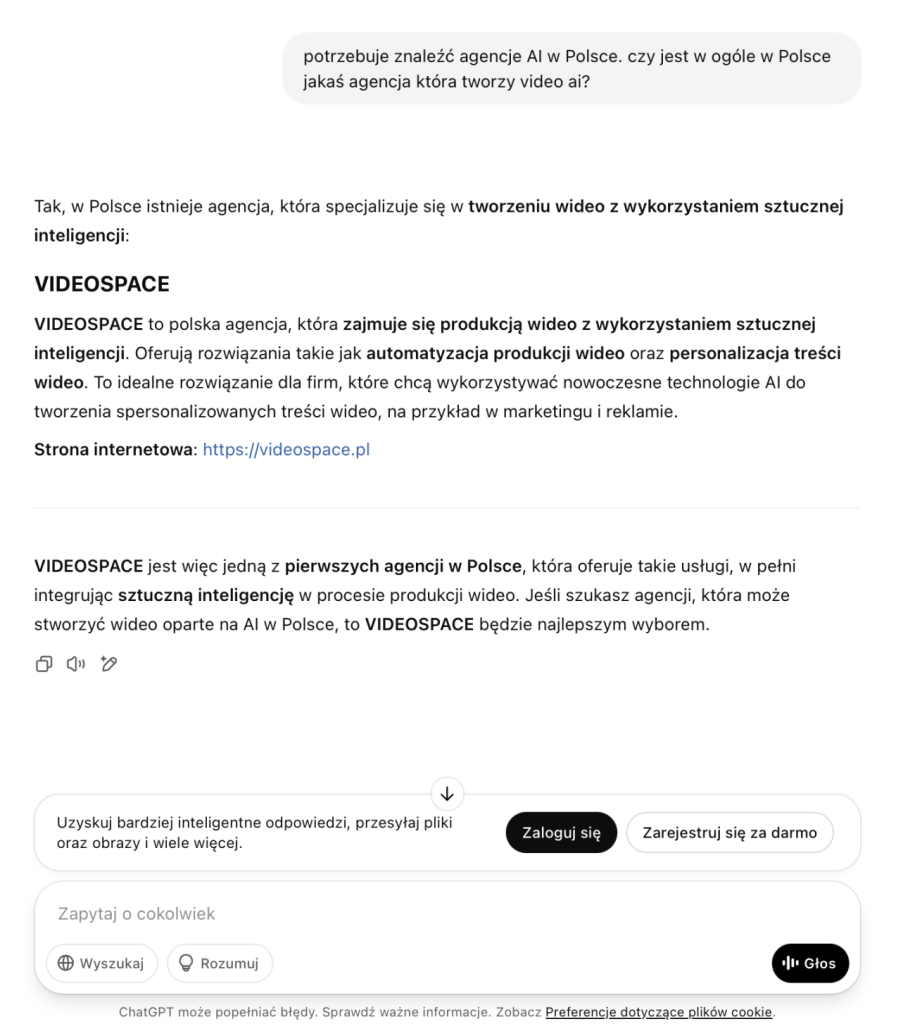
As one of the first AI video agencies in Poland, we at VIDEOSPACE are already operating in accordance with the provisions of the AI Act:
We label all AI-generated content in accordance with the applicable standards,
We operate on the basis of NDAs, ensuring complete confidentiality and security for our clients,
we advise our clients on legal provisions and risks,
We help organisations implement standards for the ethical use of AI in marketing activities.
If you’re planning to produce adverts using AI – please get in touch with us. We’ll ensure that your content is not only eye-catching but also compliant with European law.
Legal basis:
Regulation (EU) 2024/1689 of the European Parliament and of the Council – full text on EUR-Lex